going upcountry you have to know that often things will not go as planned. The plan gets lost at times, and their are moments when your only safety is with Allah, and in this way you are brought closer to Allah.
"If you just believe in the most high, you know you'll be alright." Akon Mama Africa
I expected this going in. The situation was this, I had no car and my friend had no car. One guy we knew, Seeni, had a car and he was already going upcountry to visit his Uncle, so we were just going to "tag along".
So that was the plan. But ofcourse in the upcountry Africa nothing goes according to your best laid plans...
...however...
...I did not expect that my plans would go ary before I would even get out of the city!
The city of Gambia is seperated from the upcountry of Gambia by way of the ferry. We got up early in the morning expecting to catch the first available ferry around 8am. As I mentioned, one must always expect the unexpected because it was not until 8pm that night, that we finally caught the ferry.
Our whole day was spent in a traffic jam of cars all vying for position to enter the parking lot to the ferry. The traffic jam actually appeared to move backwards, not forwards, and there is no system in which it is to move, no visible program for moving cars in and out in an orderly fashion, rather it involves payoffs for positions in lines, bargaining with officials at the gate, and at one time a member of the group actually went and opened the gate while the guard was distracted to allow the car through.
Then that wasn't the end of it. Once inside the parking lot it was then understood that one of the ferry ships was in repair, thus they were running only one ship, the wait was tremendous. The time was only eased by the companionship of other strangers all crowded together in the same mess.. somehow the common experience made way for conversation... I met a couple European guys who basically were taking their truck through all parts of West Africa, they told me nice stories of being in villages and joining in on fireside parties, drumming, dancing and so on. This is a rare quality in upcountry Africa that a stranger can engage in such events so easily as they pass from one village to the next.
I met some "Bifawl" Muslims. They basically said they were Muslim but also embraced their ancient African traditions and even pieces of Rastafarianism into their religious practice. They invited me to visit them in their hometown in Senegal.
Finally we made it across in the night, and just when I started to relax and feel comfortable underneathe the full moon as we rode alone into the night... we were stopped at a checkpoint... and then another checkpoint... and then another checkpoint... and then another checkpoint.... seemed every few miles there was another checkpoint... always interrogating and checking the car over and again.
Finally I was in the upcountry, but my mind ld not be free, as we were constantly hassled by one hang up after another until finally returning to the "freedom" and "unhassled" life of the city.
Tuesday, September 8, 2009

Wednesday, August 26, 2009
Upcountry trip to villages of Gambia
Mungo Park
S eene, Idiboy, Usman, Myself
This is another famous historical site in the upcountry of Gambia, where Scottish explorer Mungo Park began his journey across West Africa in the 14th century. He started at approximately this location. The goal of his journey was to track the course of the Niger river and he was successful. He came back a second time and was attacked and killed by locals during his second journey.
I actually went to this location twice. The first time I had told my friends I wanted to ride the canoe up the river. So one of the locals offered to take me. We went for a mile or so up the river. We stopped and began walking through the woods. I was barefoot but enjoyed seeing the nature. We walked for about a mile through the woods till we reached this monument. On the way back we passed some rice farmers. They were all women, and they were interested to see a foriegner coming through, they playfully asked me to join them in their work. Maybe if I hadn't been barefoot I would have joined them for a little while to see what it was like. On the way back the guide who took me there explained to me life on the farm, as he was a farmer himself. He also asked me if there "was anything I could do for him" and "not to tell the others that he had asked me". But I mentioned it to my friend as soon as we got back and he advised me "not to give him anything" because there were not available ATM's in the upcountry and we needed all the money to make sure we got back okay. The jeep was leeking oil and we had spent more than we expected. We even spent time at a mechanic shop in the upcountry. Here are a couple pictures of the upcountry shop where we received maintenance for our jeep...
No child labor laws here....
That's our jeep behind us being repaired...
Anyway...so as I was saying I went canoeing up the river to visit Mungo Park. Then after reaching back to the location where we were staying that night. My friends also said they wanted to see Mungo Park. So this time we went by land taking a donkey ride through the villlages out to see it. The donkey carried about 6 of us on a wooden board with wheels.
This is the means of transportation for many living in the villages. The night before I had passed through a local village but it was pitch black, as there is no electricity. So I couldn't see anything, I was just following the others. But that day I passed through a few villages in route to Mungo Park, now in the daylight. On the computer I have seen old drawings by Mungo Park of 14th century Gambia, then called "Mandingo". The drawings in his travel journals are nearly identical to the way that it still looks today in those villages.

School in the upcountry of Georgetown... The name Georgetown comes as this place was the first English colony in the Gambia, attracting many historians who document the slave trade; slave dungeons can be found here.

No.. the pic below is not me inside a slave dungeon, it is actually me at inside a home in Farefeen, this is the home of hospital staff, as the countries main hospital is in Farefeen. Farafeen is a crossroads in the Gambia's upcountry.

Here we are at the home of Mouroba Shiek, his home is on the outskirts of the tendabba village, and his place attracts many people during the Gambian holidays. Their was some mystery surrounding this part of the trip, as the Mouraba Shiek's practice a brand of Sufi Islam, in which mystical or even "magical" practices that have been a part of the region for many centuries still exist. There are secrets here. You hear things in these parts like, "Gambian families are peaceful, we do not fight in the open, but there are secret unseen battles that go on amongst opposing families, tribes, where curses may be placed on a rival family, and Shiek's are often sought out for the purpose of having these curses lifted."

There is a famous place in Senegal called Touba where a few Sufi Shieks I came in contact with had studied. Many Westerners and Orthodox Muslims may write off what they are doing as mere superstition. I tried to maintain a respect for the culture, and for the people that who follow it there is a use, purpose and meaning to what they do.

A poem I wrote at the time:
"A valuable custom is gold in one land..
useless trash in another
a tradition is vibrant in one time
old and dirty in a new time."

When you believe something it puts energy towards it's attainment. For example, a Sufi might give you a long list of activities to partake in to obtain what it is you desire. Like, "wear this ring, then go to this man in this city and buy such and such garment, wear it for such and such days and no harm will afflict you or you will get this or that thing you desire". Some involve very elaborate agenda's that can take, days, weeks, and years. In America, life never slows down enough where such practices could ever take root, but here in Western Africa time moves about much differently; it is an unhassled life, and often achieving something great can take years or even generations to achieve, and people accept this as part of life.

This was our dining room where I was staying in the upcountry. Those yellow things that look like gasoline canisters are now used to carry our water. My friend Seeni had slaughtered a goat for his Uncle. They washed it off in the river, cooked it and we were soon about to enjoy.

Seene's car had a leak, so we had to take it to an upcountry mechanic. In the picture I look to still be enjoying myself, but I know at the time I was not. I knew we would make it back eventually, it was just the type of thing where I was somewhat reluctant about the upcountry trip to begin with, and then just like the year before, one thing after another seems to go wrong in the upcountry. All plans quickly go by the wayside. You really have to forget time, and forget about expectations and just learn to experience what is happening the way African's do.

Breakfast at the hotel.
S
 eene, Idiboy, Usman, Myself
This is another famous historical site in the upcountry of Gambia, where Scottish explorer Mungo Park began his journey across West Africa in the 14th century. He started at approximately this location. The goal of his journey was to track the course of the Niger river and he was successful. He came back a second time and was attacked and killed by locals during his second journey.
I actually went to this location twice. The first time I had told my friends I wanted to ride the canoe up the river. So one of the locals offered to take me. We went for a mile or so up the river. We stopped and began walking through the woods. I was barefoot but enjoyed seeing the nature. We walked for about a mile through the woods till we reached this monument. On the way back we passed some rice farmers. They were all women, and they were interested to see a foriegner coming through, they playfully asked me to join them in their work. Maybe if I hadn't been barefoot I would have joined them for a little while to see what it was like. On the way back the guide who took me there explained to me life on the farm, as he was a farmer himself. He also asked me if there "was anything I could do for him" and "not to tell the others that he had asked me". But I mentioned it to my friend as soon as we got back and he advised me "not to give him anything" because there were not available ATM's in the upcountry and we needed all the money to make sure we got back okay. The jeep was leeking oil and we had spent more than we expected. We even spent time at a mechanic shop in the upcountry. Here are a couple pictures of the upcountry shop where we received maintenance for our jeep...
No child labor laws here....
That's our jeep behind us being repaired...
Anyway...so as I was saying I went canoeing up the river to visit Mungo Park. Then after reaching back to the location where we were staying that night. My friends also said they wanted to see Mungo Park. So this time we went by land taking a donkey ride through the villlages out to see it. The donkey carried about 6 of us on a wooden board with wheels.
This is the means of transportation for many living in the villages. The night before I had passed through a local village but it was pitch black, as there is no electricity. So I couldn't see anything, I was just following the others. But that day I passed through a few villages in route to Mungo Park, now in the daylight. On the computer I have seen old drawings by Mungo Park of 14th century Gambia, then called "Mandingo". The drawings in his travel journals are nearly identical to the way that it still looks today in those villages.

School in the upcountry of Georgetown... The name Georgetown comes as this place was the first English colony in the Gambia, attracting many historians who document the slave trade; slave dungeons can be found here.

No.. the pic below is not me inside a slave dungeon, it is actually me at inside a home in Farefeen, this is the home of hospital staff, as the countries main hospital is in Farefeen. Farafeen is a crossroads in the Gambia's upcountry.

Here we are at the home of Mouroba Shiek, his home is on the outskirts of the tendabba village, and his place attracts many people during the Gambian holidays. Their was some mystery surrounding this part of the trip, as the Mouraba Shiek's practice a brand of Sufi Islam, in which mystical or even "magical" practices that have been a part of the region for many centuries still exist. There are secrets here. You hear things in these parts like, "Gambian families are peaceful, we do not fight in the open, but there are secret unseen battles that go on amongst opposing families, tribes, where curses may be placed on a rival family, and Shiek's are often sought out for the purpose of having these curses lifted."

There is a famous place in Senegal called Touba where a few Sufi Shieks I came in contact with had studied. Many Westerners and Orthodox Muslims may write off what they are doing as mere superstition. I tried to maintain a respect for the culture, and for the people that who follow it there is a use, purpose and meaning to what they do.

A poem I wrote at the time:
"A valuable custom is gold in one land..
useless trash in another
a tradition is vibrant in one time
old and dirty in a new time."

When you believe something it puts energy towards it's attainment. For example, a Sufi might give you a long list of activities to partake in to obtain what it is you desire. Like, "wear this ring, then go to this man in this city and buy such and such garment, wear it for such and such days and no harm will afflict you or you will get this or that thing you desire". Some involve very elaborate agenda's that can take, days, weeks, and years. In America, life never slows down enough where such practices could ever take root, but here in Western Africa time moves about much differently; it is an unhassled life, and often achieving something great can take years or even generations to achieve, and people accept this as part of life.

This was our dining room where I was staying in the upcountry. Those yellow things that look like gasoline canisters are now used to carry our water. My friend Seeni had slaughtered a goat for his Uncle. They washed it off in the river, cooked it and we were soon about to enjoy.

Seene's car had a leak, so we had to take it to an upcountry mechanic. In the picture I look to still be enjoying myself, but I know at the time I was not. I knew we would make it back eventually, it was just the type of thing where I was somewhat reluctant about the upcountry trip to begin with, and then just like the year before, one thing after another seems to go wrong in the upcountry. All plans quickly go by the wayside. You really have to forget time, and forget about expectations and just learn to experience what is happening the way African's do.

Breakfast at the hotel.
Monday, August 24, 2009
A long long day waiting for the ferry....
We were on a trip from Gambia to Senegal, you have to cross the River Gambia to get to Senegal, and therefore you must use the government serviced ferry to accomplish this. We were supposed to cross around 8am in the morning, so we awoke very early and set out on our journey... we ended up spending the whole day trying to accomplish this great feat, and it took much maneuvering and manipulating of cars, people, and officials to accomplish this. It wasn't until nightfall that we finally crossed. This set of video's details the days events, and how things can sometimes go wrong when traveling abroad.
Sunday, August 23, 2009
My guesthouse in Gambia
The process for finding this chill spot wasn't completely easy. Our first stop was actually at a distant cousins of Idiboy's. It seemed like a nice place and Idiboy was saying we may even be able to stay for free if we made a good impression on his cousin. So there I was just having arrived, took my first shower in 3 days in a makeshift shower outside the home. The home was locked so we could only get inside this small little guest unit that was just outside. I took a quick shower and threw on some boxers, I think I was still waiting for a towel before I would put on the rest of my clothes. I had not ate in a long time, and Idiboy had picked up some food at a stop along the way. So I sat down in the driveway in just my boxers eating the food (their was a gate so I wasn't in plain site of cars passing by, but still I felt somewhat uncomfortable awaiting my clothes). Just then his cousin came in, I was still just in my boxers, and having to explain myself, who I was, shake his hand, all while soaking wet in nothing but underwear. Probably didn't make the best impression. He did go ahead and move out all his things from his room so that I could use his room. But the funny thing was his room was all American style, Eminem, Britney Spears posters, all American music like Usher or Kanye West at the stereo system. In the room I really felt like I was not in Africa at all, like I was in America. Which it was kind of a bummer to travel so far and feel like you never left. After a day or two there, Idiboy and I agreed it wasn't our style, and his cousin was going to charge us quite a bit of money anyway... so we looked for a spot that was more our style and came up with this one.
Video of my guesthouse in the Gambia. All the essentials are there, nice shower, toilet (which is not always available, some places you have to take bath with buckets of water or use restroom that's just whole in the ground).

Also I have nice view outside of palmtree's...

View of the outer exterior...

Some kids came to do a show inside the property, some traditional drumming...

...the outside of my guesthouse...

This is the owner Sidi...

Sidi also stayed on the property and lived right here...

A kitchen in my guesthouse...

pic of my bedroom...

...and even living room area.

...Small rooms though, but everything I needed was there. Sometimes the owner of the guesthouse had to go refill the water from uptop they had this watertower supplying the 4 guesthouses.
Video of my guesthouse in the Gambia. All the essentials are there, nice shower, toilet (which is not always available, some places you have to take bath with buckets of water or use restroom that's just whole in the ground).

Also I have nice view outside of palmtree's...

View of the outer exterior...

Some kids came to do a show inside the property, some traditional drumming...

...the outside of my guesthouse...

This is the owner Sidi...

Sidi also stayed on the property and lived right here...

A kitchen in my guesthouse...

pic of my bedroom...

...and even living room area.

...Small rooms though, but everything I needed was there. Sometimes the owner of the guesthouse had to go refill the water from uptop they had this watertower supplying the 4 guesthouses.
ganja in Africa

As I explained before, the Rasta culture is huge in Gambia. And they don't call Gambia "the smiling coast" for nothing. Marijuana is a part of daily life in the country. It goes along with battling the elements such as digesting the food, the hot weather, mosquitoes, crowded streets and hustle of city life. Somehow the ganja blends beautifully with the life there. They have adopted Jamaica's Rasta culture in Gambia and ofcourse ganja is a big part of the Rasta way. Even strict Muslims and proffesionals engage in it's use in Gambia. People may pass by, see friends, have a seat, drink some tea, and pass around some ganja with their tea. The most popular song in my time in Gambia was a song called "Ganja Farmer". The songs lyrics go like this...
"Some ganja plant-a...
call me the ganja farmer...
it's a million ways (somethin somethin) ganja
Babylon comes to put my farm on fire....
...I'm a ganja planter....
...Call me the ganja farmer!"
I took this article about marijauna from a travel website about Gambia
http://www.accessgambia.com/information/ganja-drug.html
Ganja is the name for Marijuana (Pot), and seems to be more prevalent than liquor given the Islamic restrictions on alcohol consumption. Be aware that partaking and possessing Ganja is illegal in The Gambia. "Cannabis" is also used to describe the substance.
WARNING:
Never engage in illegal drugs. Penalties and prisons in Gambia are harsh.
Cannabis grows naturally in The Gambia and other parts of Africa and has been used as a recreational drug for centuries but its abuse is now widespread in both rural and urban populations in Africa (United Nations, 1989). The potency of cannabis varies widely geographically, with reduced levels of the major active principal, delta-9 tetrahydrocannabinol (THC) found in plants grown in cold climates; cannabis in West Africa is likely, therefore, to be highly potent. In The Gambia there are three cannabis harvests per year and its low cost, and ready availability favour its widespread use. The cannabinoids are highly lipophilic and accumulate in body fat, leading to a long half-life in chronic users (Harvey, 1985).
British Journal of Psychiatry (1993) 163, 798-801
This is one of my friends houses in the Gambia. This give you an idea of what many of the homes are like in the Gambia, both inside out outside the home.

That's my friends step-father in the picture. I think around 5 young men and women, 4 kids, 3 elderly people live in this house. As the family expands they build onto the house little by little. As you see behind the man sitting there is a house made up of about 3 -4 seperate rooms. Then across from him there is another small home made up of a couple of rooms. The bathroom is outside the two homes towards the edge of the property and is similar to what outhouses were like in America. The taxi's in the driveway are no longer in working condition. Idiboy's brother Adam is a mechanic and I think he had been working on the two taxi's, but no luck.

You see pictures on his walls of Reggae artists, along with a picture of a famous Islamic Sufi Shiek named Ibrahim Nayass. His branch of Sufism known as Tijani is the most popular practice of Islam I found in Senegal and Gambia. Although my friend wasn't really practicing Tijani himself, his mother and some other family members were more into it. Traditional Tijani Sufi's will gather on Friday's for "wassifa" where they will form circles and call out the names of Allah in unison till the energy biulds into a euphoria that is said to bring them closer to Allah.
Another picture you may notice is actually of Muammar Quadafi. I had to ask who it was because I couldn't tell just by looking at the poster. It appears to be a younger version of Kadafi. Kadafi tried to form the African United States and unite the whole continent of Africa, so he has one favor amongst black African's for being a Pan-African, African pride symbol-figure. Although ofcourse he is very controversial in other parts of the world, but regular locals in the Gambia seem to like him.

Along with the Reggae/Rasta posters you can also see a poster of 50 Cent. Not only do Gambians love hip-hop and American culture, but I think it is also a source of pride and inspiration for Africans to see blacks in the US achieve such levels of fame. Anybody from 2pac, Suge Knight, to Barack Obama, Snoop, Michael Jackson, these are all inspirational figures for them. Although part of it has less to do with black pride, and America's cultural influence in general, because you will even see Eminem t-shirts and posters around the region.
These videos below shows me eating in the house, it looks like it was a bowl of rice and maybe some chicken or fish, and patatoes, carots maybe.. very good, and even more blessings because it was shared with others.
Thursday, August 13, 2009
Time to "Breathe"
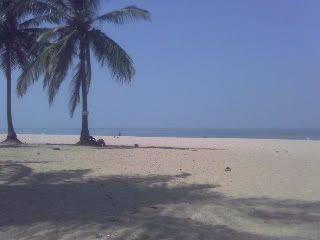
My thoughts are deep
I speak and watch words fall from clouds
They beat upon the bottom of the ocean beneathe
Travelling the Earths crust
the daily hustle of life
the uncomfortable stress
everyone has to take a moment to breathe
to see thoughts slowly
to heal the disease
the dis-eases of the heart
I'm always aiming to please
but sometimes my needs
may be in conflict with yours
so we start wars
and find closed doors
when we try to move towards
each other
...so just let me pass
and just move along
by myself
and be one
until the day these gray clouds roll away and I can see the sun
Subscribe to:
Posts (Atom)
